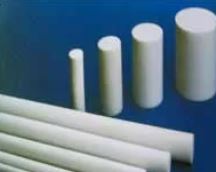
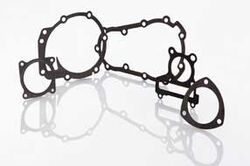
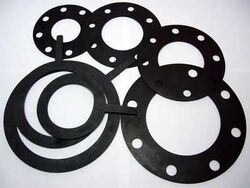
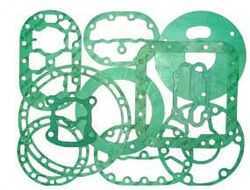
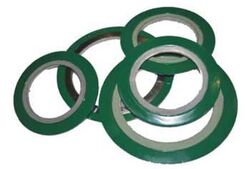
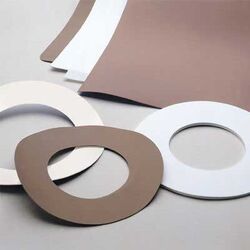
PTFE Rods exhibit astonishing chemical resistance. PTFE is a self-lubricating material that provides a low friction coefficient, and is ideally suited for the manufacture of corrosion-resistant gaskets & seals. PTFE stands for PolyTetraFluoroEthylene. it is a fluorocarbon-based polymer.
FEATURES OF PTFE ROD:
Easily outperform other engineering plastics by being able to perform continuously at temperatures of -250°C, right up to an +250°C
It has an outstanding co-efficient of friction
It also has a very good acid and chemical resistance
...
PTFE Rods exhibit astonishing chemical resistance. PTFE is a self-lubricating material that provides a low friction coefficient, and is ideally suited for the manufacture of corrosion-resistant gaskets & seals. PTFE stands for PolyTetraFluoroEthylene. it is a fluorocarbon-based polymer.
FEATURES OF PTFE ROD:
Easily outperform other engineering plastics by being able to perform continuously at temperatures of -250°C, right up to an +250°C
It has an outstanding co-efficient of friction
It also has a very good acid and chemical resistance
Another feature of PTFE is its ability to set by or due to compression
PTFE has excellent electrical resistance
PTFE is water repellent and can be used in the manufacture of modern high performing, water repellent and breathable clothing
DATA INFORMATION FOR PTFE ROD:
PTFE is a synthetic fluoropolymer.
Maximum long term working temperature is plus 260°C.
Maximum short term working temperature is plus 260°C
Melting point is plus 327°C.
Co-efficient of friction is 0.08.
Density is 2.18g/cm3
ADDITIVES OF PTFE ROD:
Although PTFE is an excellent material, PTFE Rod can further be enhanced by adding performance enhancers into the production process such as molybdenum, bronze, graphite etc. This can further expand its suitability for other applications.
ADHESIVES FOR PTFE ROD:
PTFE is very slippery but there are specialist adhesives produced specifically to bond it either to more PTFE or to bond the PTFE to other materials. This often involves a primer which etches the surface of the PTFE Rod to prepare the initial surface and the adhesive is then applied to complete the bonding process. This is more complicated in terms of having a two part process than other bonding systems but if you require any assistance with this, we recommend you contact an adhesive specialist.
POINTS TO REMEMBER ABOUT PTFE ROD:
Softness of PTFE Rod – PTFE Rod is softer than other engineering plastics and this may cause damage to the material if gripping or clamping in machine tools such as lathes or milling machine vices. In addition, threading PTFE rod would produce threads of limited strength
Thermal Expansion – PTFE has a marginally higher than average thermal expansion rate. This means that components will increase/decrease in size due to temperature fluctuations
Bonding – Bonding PTFE rod can be a little more involved than with some other engineering plastics
Weight – PTFE is much denser than most other engineering plastics. This means there is an increase of weight over other plastic
Read More